
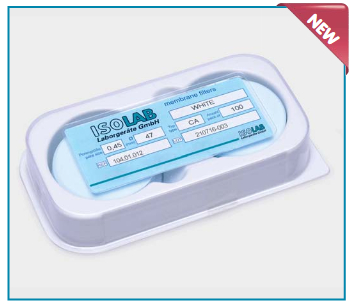
MEMBRANE FILTERS
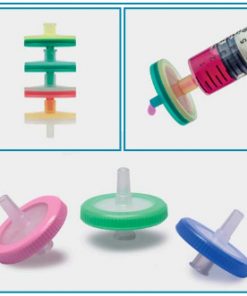
- Membrane filtration offer a very convenient, fast and economical separation method.
They offer below mentioned advantages;
- Excellent level of particle retention
- Large load carry capacity
- High permeability to air
- Non-hygroscopic and biologically inert
- Chemical resistance to most solvents and reagents.
- Very high temperature resistance
Available 2 products:
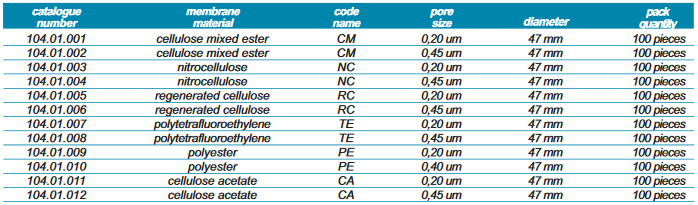
- filters with 0,45 μm pore size
- filters with 0,20 μm pore size
CM: cellulose mixed ester membrane
Particularly suitable for aqueous solutions. They are hydrophilic. Thermally stable to 121°C. Ideal for gravimetric analysis and are often used for contamination tests.
NC: nitrocellulose membranes
They are easily wettable and suited for filtration of aqueous solutions. In dry athmosphere these membranes are thermally stable at 125°C and can be autoclaved at 121°C. RC: regenerated cellulose membranes These membranes are resistant to most organic solvents. They are mostly used for filtration of solvent mixtures and ultra-purification and degassing of HPLC eluents.
TE: polytetrafluoroethylene membranes
Particularly suitable with aggressive media, as well as to concentrated acids and bases. They are hydrophobic, they can be used up to 145°C.
PE: polyester membranes
They are hydrophilic. Particularly suitable for fine titration, dust analysis, aerrosol analysis and ultra-purification of solvents.
CA: cellulose acetate membranes
They have a low protein binding capacity and they are suited for aqueous and alcoholic media. They are hydrophibic and can be used for hot gases up to 180°C.

Related products
Choromatography & Spectroscopy
Choromatography & Spectroscopy
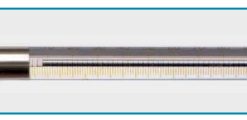
SYRINGES – “for dosage of gas & liquids” – “fixed needle” – “serie H”
Choromatography & Spectroscopy
Choromatography & Spectroscopy
Choromatography & Spectroscopy
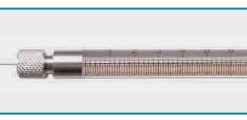
SYRINGES – “for dosage of gas & liquids” – “removable needle” – “serie H”

Choromatography & Spectroscopy
Choromatography & Spectroscopy
SYRINGES – “for dosage of liquids” – “removable needle” – “serie RN”
Choromatography & Spectroscopy